
Services
Commercial Restroom Deep Cleaning in Fremont
Commercial restroom deep cleaning that picks up where routine janitorial visits stop, for Fremont, Hayward, Milpitas, Newark and Union City properties.
What routine restroom care covers, and what it leaves for later
On a standard janitorial visit, restrooms are cleaned and restocked, contact surfaces are wiped and floors are done last so they stay clean on the way out. That keeps a restroom in working order day to day.
Over weeks and months, though, a restroom picks up things a routine visit was never meant to reach. Scale forms inside bowls and along faucet bases. Grout absorbs a little soil with every mopping. Dust gathers on the exhaust grille, the light diffuser and the top edge of each partition. Removing that build-up takes its own scheduled visit, after which the everyday crew has a fresh room to keep up.
What a commercial restroom deep cleaning covers
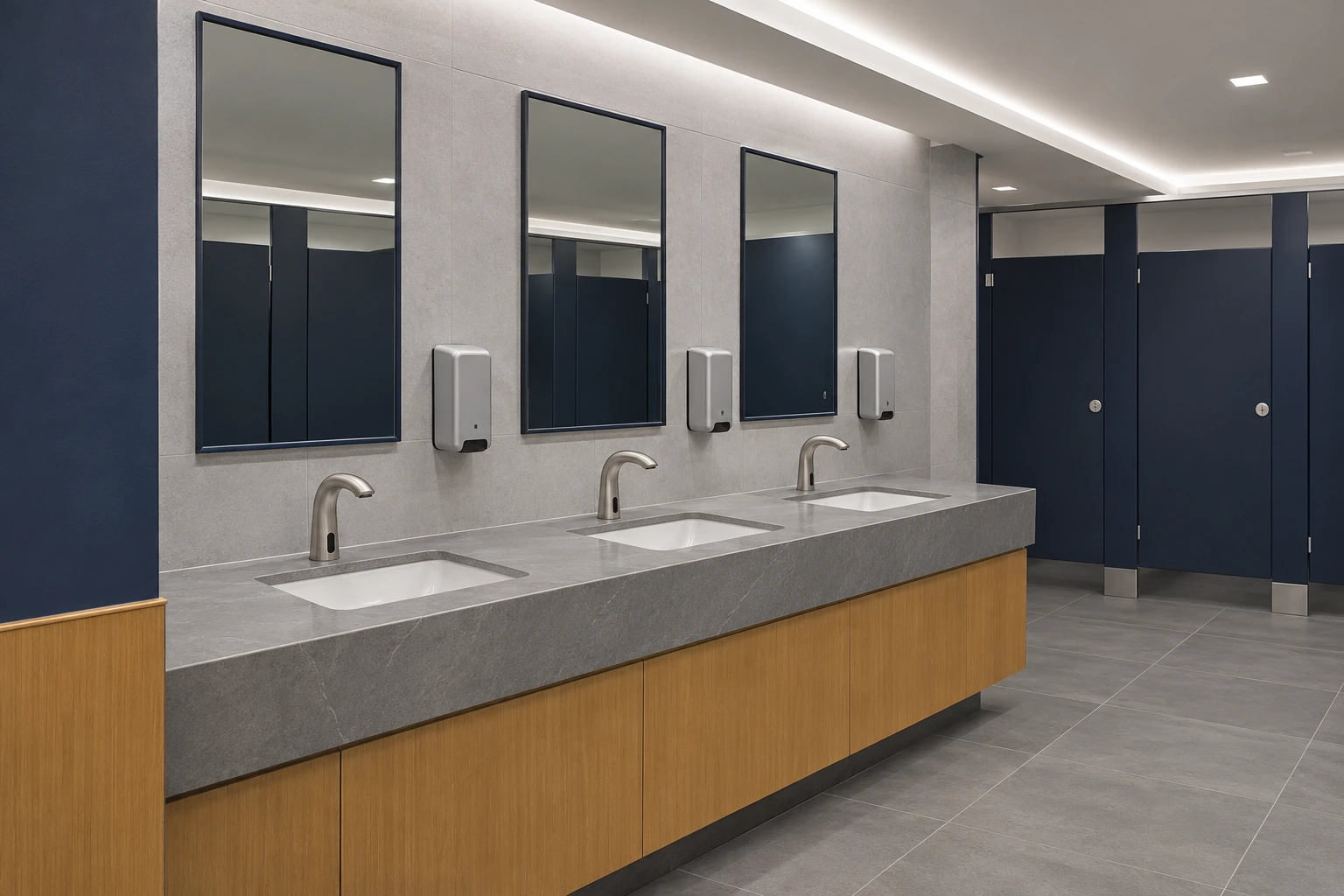
Every commercial restroom deep cleaning visit covers five parts of the room:
- Fixtures: toilets, urinals, sinks and faucets descaled and detailed
- Partitions: stall walls, doors, hinges and hardware washed on both faces
- Floors and drains: tile and grout machine-scrubbed, drain grates lifted and drains flushed
- Dispensers: soap and towel units wiped down and refilled, hand dryers detailed
- High-touch points: door pulls, flush handles, faucet levers and light switches treated with an EPA-registered disinfectant for its label dwell time
The checklist below breaks each part into its individual tasks, and the interval you choose decides how deep each visit goes.
The deep clean checklist
- Tile and grout worked over by a scrubbing machine, with the soiled water vacuumed off right behind it
- Descaling on every toilet, urinal and sink, with attention to each base, the hidden rear surfaces and the floor joint
- Drain grates lifted and each drain body scrubbed and flushed
- Both faces of every stall divider and door washed, and the wall tile or wainscot from its upper edge down
- High dusting: exhaust grilles, light diffusers and the ledges above the mirrors
- Towel and soap dispensers, dryers, faucet sets and flush valves detailed
- Baseboards and corners cleaned by hand
- Odor tracked down to stained grout, drain openings and the tile under each urinal, then cleaned away instead of covered up
Choosing an interval for each restroom
Restrooms in the same building rarely wear at the same speed, so each one can be placed on the interval that fits its use.
Weekly visits keep busy restrooms from slipping:
- Descaling touch-ups wherever chrome or porcelain shows a film
- Stall panels and doors wiped, hinges included
- Drains flushed
- Edges and corners scrubbed
Monthly visits reach the larger surfaces:
- Machine scrubbing across the floor and grout
- Wall tile washed
- Vents and high areas dusted
- Dispensers and dryers detailed
Quarterly visits restore the whole room:
- Built-up scale taken down on each toilet, urinal and sink
- Deep grout restoration scrub
- Partition and wall surfaces washed throughout
- Light diffusers washed and every surface in reach detailed
Use, more than size, decides the interval. A shopping-center restroom beside a food court or a school restroom used by several hundred students fits a weekly cycle. The restrooms nearest a plant’s production floor often fall in that group too. A small professional suite with a single-stall restroom usually needs only a quarterly visit.
Disinfection with time to work
Every toilet seat, flush handle, faucet and door pull is treated with an EPA-registered disinfectant. Soil is cleaned off first so the disinfectant touches the surface itself. The product is then left in place for the dwell time given on its label, and only after that is it wiped away.
The same approach applies whether the restroom serves a medical office waiting room, a shift crew or an office floor, so every building you have gets the same result.
Fremont-area facilities that need it
Restroom deep cleaning makes the biggest difference where restrooms see a steady stream of people. By building type, that means office buildings and shared tenant floors, shops and shopping centers, schools and daycares, and medical offices.
It also suits gyms and locker rooms, restaurant dining-room restrooms, churches, temples and gurdwaras after large gatherings, and the shift restrooms in plant and warehouse support areas covered by industrial cleaning.
What a deep clean changes
- Clean air with no lingering odor, since its causes are gone
- Fixtures and grout kept in service longer
- Fewer restroom complaints reaching the front desk
- Restrooms you are happy to walk a client or an inspector through
- A better impression on everyone who walks in
Scheduled around your hours
Crews come in after closing or over a weekend. Multi-restroom buildings are worked in sequence, each room finished before the next is closed, so one stays open the whole time. Where one restroom serves the entire office, the crew comes during hours when nobody needs it. Work is coordinated with your recurring evening crew, and if you use our day porter service, the porter’s daytime restroom checks hold the results.
Plants that run around the clock can schedule each restroom during a shift change or a planned shutdown, and offices can pick a weekend so floors have time to dry.
Factors behind the price
- The size of the job: restrooms, stalls, urinals and sinks
- How worn each room is at the start, scale included
- The interval chosen
- Floor and wall surfaces
- Access hours
A walkthrough of each restroom gives us what we need to prepare your quote.
A few useful answers
Common questions
Our janitorial visits already cover restrooms. Where does a deep clean go further?
Janitorial visits clean fixtures, wipe contact surfaces, restock supplies and finish the floor. The deep clean adds a scheduled visit, weekly, monthly or quarterly, for the work those visits skip: grout lines, mineral deposits, drains, exhaust grilles and complete wall and partition washing.
Can restrooms near a production floor be deep cleaned without stopping a shift?
Yes. The crew works during a shift change, a break between shifts or a planned shutdown, and handles one restroom while another stays available to the line.
Which restrooms in a multi-tenant building should go on a weekly schedule?
Usually the lobby and ground-floor restrooms, since visitors and tenants from every suite pass through them. Upper-floor restrooms used by one tenant often hold up on a monthly cycle.
Can a temple or gurdwara book a deep clean after a festival or large community meal?
Yes. A one-time deep clean can be added after a festival, holy day or large meal, in addition to any regular schedule.
What does a commercial restroom deep cleaning include?
Fixtures descaled, partitions washed on both faces, tile, grout and drains scrubbed and flushed, dispensers detailed and every high-touch point disinfected, on the interval set for that restroom.
Services